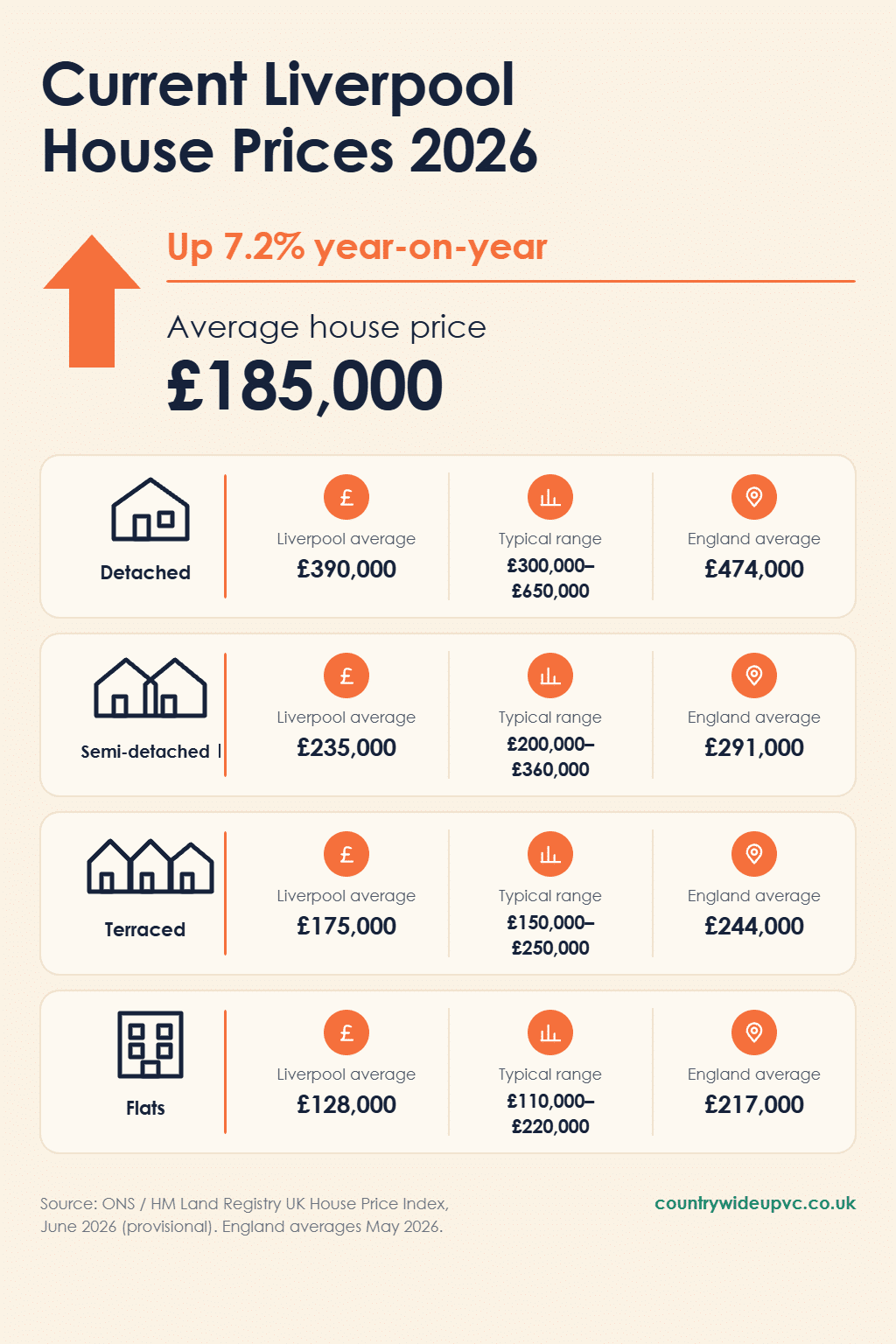
House prices in Liverpool have risen 7.2% year-on-year, reaching an average of £185,000 in June 2026, according to the ONS and HM Land Registry UK House Price Index. That is up from £173,000 in June 2025, and it puts Liverpool ahead of the 4.7% annual growth recorded across the North West and the 2.0% recorded across the UK as a whole.
Liverpool house prices break down by property type as follows, with England averages shown for comparison:
| Property Type | Liverpool Average (June 2026) | England Average | Typical Liverpool Range |
|---|---|---|---|
| Detached Houses | £390,000 | £474,000 | £300,000-£650,000 |
| Semi-Detached Houses | £235,000 | £291,000 | £200,000-£360,000 |
| Terraced Houses | £175,000 | £244,000 | £150,000-£250,000 |
| Flats/Maisonettes | £128,000 | £217,000 | £110,000-£220,000 |
House prices in Liverpool remain around 16% below the North West average of £220,000 and roughly 37% below the England average of £293,000. That gap is what makes strategic property improvements worthwhile here, because installation costs sit much closer to national averages than local property values do.
Sold house prices in Liverpool sit inside the strongest regional market in England. The North West recorded the highest annual growth of any English region in the year to June 2026, while London values fell 2.5%. Liverpool’s 7.2% growth outpaced the wider region.
Steadier borrowing costs and the strongest regional market in the country mean current conditions support home improvement spending, with values rising while Liverpool stays affordable against national averages.
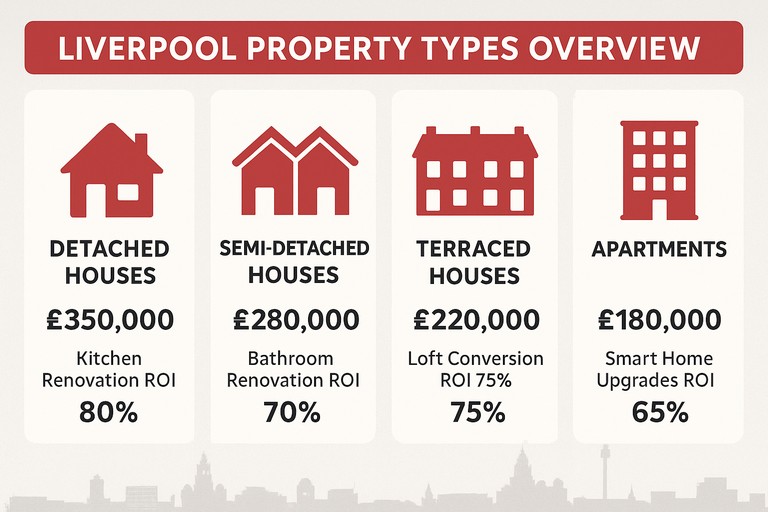
Strategic home improvements to properties in Liverpool can add between 2% and 20% in value, depending on the work. The figures below use the current average Liverpool house price of £185,000 and 2026 installation costs.
The improvements returning the most for Liverpool properties are:
Conservatories add 5-7% to Liverpool property values, roughly £9,250-£12,950 on an average home. Modern conservatories with solid roofs provide:
Conservatory costs in 2026 typically run from £10,250 for a uPVC lean-to to £12,750 for a Victorian style at 3.5m x 3.5m, with orangeries closer to £32,500. Returns are modest against cost, so the case rests on usable space rather than resale value.
Every private rented home in England must reach EPC C by 1 October 2030. The government confirmed the standard on 21 January 2026 as part of the £15 billion Warm Homes Plan, dropping the earlier two-stage timetable in favour of one deadline covering new and existing tenancies.
The effect on values is already measurable. Nationwide research published in 2026 found A or B rated properties command a 12.2% premium in the buy-to-let market against comparable D rated homes. For owner-occupiers the premium is smaller at 1.6%, while F and G rated homes sell at a discount of around 1.4%.
For Liverpool landlords, that turns window and door replacement from a discretionary upgrade into scheduled compliance work with four years of notice.
The average rent in Liverpool is £909 per month as of July 2026, up 5.7% from £860 a year earlier according to ONS private rent data. That sits below the North West average of £965 and well below the UK average of £1,393.
| Property Size | Average Liverpool Rent (July 2026) |
|---|---|
| One bedroom | £683 |
| Two bedrooms | £834 |
| Three bedrooms | £959 |
| Four or more bedrooms | £1,288 |
The Liverpool rental market shows the following characteristics:
Investment property Liverpool attracts buyers seeking:
Installation costs have stabilised but are still climbing. Material prices levelled off after the sharp increases of 2021 to 2023, and BCIS forecasts a further 13% rise in its Materials Cost Index between 2025 and 2030. Labour is now the larger driver, running 7.1% up year-on-year. Deferring a job rarely makes it cheaper.
For Liverpool homeowners prioritising returns, we recommend this order:
Working with established local contractors ensures:
We serve homeowners across Liverpool, Maghull, Ormskirk, Formby, Crosby and Southport with guidance on value-enhancing renovations.
The Liverpool property price forecast remains positive through 2030. Savills forecasts 27.6% house price growth across the North West between 2026 and 2030, against 22.2% for the UK and 13.6% for London, placing the region in the top group nationally alongside Yorkshire, the North East, Scotland and Wales.
Savills UK annual forecasts run as follows: 2.0% in 2026, 4.0% in 2027, 5.0% in 2028, 5.5% in 2029 and 4.0% in 2030.
House price predictions for the next 10 years suggest Liverpool will keep outperforming national averages, driven by its affordability gap and its development pipeline.
The current Liverpool housing market creates strong conditions for home improvements. Prices are rising at more than three times the UK rate while remaining affordable, so money spent on the fabric of a house is not being spent into an inflated market.
Our analysis shows window replacement, composite doors and rooflight loft conversions give Liverpool properties the best combination of added value, energy saving and compliance. These improvements lift EPC ratings, cut running costs and appeal to buyers and tenants in a rental market growing at 5.7% a year.
For homeowners across Merseyside and Lancashire, the combination of rising values, strong rental demand and a confirmed 2030 energy standard makes this a sensible point to plan renovation work rather than defer it.
Contact our team today to discuss how strategic home improvements can raise your Liverpool property’s value while cutting its running costs.
No, house prices in Liverpool are not going down. Values rose 7.2% in the year to June 2026 to an average of £185,000, faster than both the North West at 4.7% and the UK at 2.0%. Savills forecasts a further 27.6% growth across the North West between 2026 and 2030.
Yes, Liverpool offers strong value for property buyers. At an average of £185,000, homes are around 16% cheaper than the North West average and 37% cheaper than the England average, while gross rental yields of 5.3% beat the England average of 3.6%. First-time buyers pay an average of £171,000.
South Liverpool holds the city’s highest values, led by Sefton Park, Woolton and Aigburth. Large Victorian houses around Sefton Park reach £500,000 to £850,000 and above, while detached homes in Woolton run from £400,000 to £650,000 plus. Waterfront apartments in the city centre also command premium prices.
The Georgian Quarter and Hope Street area are Liverpool’s most prestigious residential locations, with period properties, tree-lined streets and the Cathedral and Philharmonic Hall on the doorstep. Woolton village, Aigburth, Mossley Hill and the streets around Sefton Park are the other established affluent areas.
Liverpool property is affordable because of regional income differences rather than any weakness in the current market. Average earnings in the city are around £30,947, well below the South East, which holds prices down. A Liverpool home takes about 4.6 years of median salary against 7.5 years across England and Wales. Values are now rising faster than the national average as regeneration continues.
Yes, Liverpool is in a sustained period of regeneration. The £5.5 billion Liverpool Waters scheme broke ground on its 26-acre Central Docks neighbourhood in 2025, Everton’s Hill Dickinson Stadium opened the same year at a cost of more than £500 million and will host Euro 2028 matches, and the Knowledge Quarter and Baltic Triangle continue to expand.
Living costs in Liverpool average around £1,328 a month for a single person. That covers rent of roughly £893, energy and water of about £189 and Band D council tax of £2,674 a year. Average rent across all property sizes is £909, against £1,393 across the UK.
Liverpool ranks among the UK’s more liveable cities on cost, culture and connectivity. It has three universities, world-class museums and a waterfront that is being rebuilt, and housing costs take a smaller share of income than in most large English cities. Ongoing regeneration and transport investment continue to improve the picture.
New windows can add up to 10% to a property’s value on industry estimates, around £18,500 on an average Liverpool home, though the measurable effect on sale price depends on what they replace. The clearer financial case is the £85 a year energy saving against single glazing, a better EPC rating, and the 12.2% premium A and B rated homes command in the buy-to-let market.
A full replacement for a 3-bed house typically costs £8,000 to £15,000 depending on window count, style and frame material. Individual casement windows average around £1,000 supplied and fitted, with sash and bay windows costing more. Liverpool prices sit at or slightly below national averages.
Data current as of August 2026. House price and rent figures from the ONS and HM Land Registry UK House Price Index, June and July 2026 releases. Property values vary by location and condition.

Countrywide Upvc (NW) Ltd | Double Glazing | UPVC Windows & Doors
104 New Ct Way
Ormskirk
L39 2YT
Lancashire - 01695 579 764
Liverpool - 0151 245 7067
info@countrywideupvc.co.uk
Opening Hours
Monday to Friday: 9 am – 5 pm
Saturday & Sunday : Closed


Sitemap | Privacy | Contact Us | Checkatrade | FENSA | Trustpilot